Showing posts with label UK. Show all posts

Wednesday, November 30, 2011

More hysterical censorship from the UK

Source
This transit ad, from the UK's Marks & Spencer chain, has been banned by the kingdom's ad regulator for being too sexy.

From their ruling:

"We noted the complainants’ concerns that this ad, displayed on buses, was likely to be seen by children. We considered that most children viewing the ad would understand that the poster was advertising lingerie and, as such, the models would not be fully clothed. We considered that the pose of the woman lying on the bed was only mildly sexual in nature, and as a result was unlikely to be seen as unsuitable to be seen by children. However, we considered that the pose of the woman kneeling on the bed was overtly sexual, as her legs were wide apart, her back arched and one arm above her head with the other touching her thigh. We also noted that the woman in this image wore stockings. We considered that the image was of an overtly sexual nature and was therefore unsuitable for untargeted outdoor display, as it was likely to be seen by children. We concluded that the ad was socially irresponsible."
If you read this blog, you know my stand on this. Using sex to sell everything is just lazy. Objectifying women in ads is insulting. But those are my opinions, not things I want regulated.

I honestly believe that we, as consumers, need to decide for ourselves what we are willing to tolerate from advertisers. Sexual exploitation of women in ads is so commonplace, in ads aimed at both men and women, that I'm surprised it has any breakthrough potential at all anymore. My 7-year-old son, just last weekend, was stopped in his tracks by a larger-than-life POP poster at Sears showing a woman in see through underwear. But that stopping power wears off. (In his case, he just blurted out "booby covers!" and laughed.)

You can choose to complain to a business about their ads. Or you can choose to not do business with them. You can choose to complain to the owner of the media. But this knee-jerk banning that's happening with the ASA in the UK really seems over the top to me. Plus, it only works into the offending advertisers hands by giving people a reason to take notice of their ads.

Generally, in social marketing, we feel that it's more effective to recognize and reinforce good behaviour than punish and shame bad. Imagine if organizations like the ASA put more of their efforts into celebrating the advertisers who are "socially responsible",  giving them the free PR while the naughty ones languished in the oversaturated sexy soup of the ad landscape. Wouldn't that be nice?

Via The Drum and The Telegraph

Thursday, November 17, 2011

UK fashion brand takes a ribbing over super-skinny model pics


Fashionista reports that the UK Advertising Standards Authority ordered Drop Dead Clothing to remove the above bikini photos of Scottish model Amanda Hendrick from their online catalogue:
“The ASA considered the model was very slim. We also noted that in the bikini and denim shorts images, hollows in her thighs were noticeable and she had prominent thigh bones,” the ruling said. “We considered that in combination with the stretched out pose and heavy eye make-up, the model looked underweight in the pictures.”
The Daily Record says Carol Sykes, of Drop Dead Clothing, has accepted the ruling but not the rationale.
"Amanda is not anorexic or unhealthy and eats a very good diet. She's just a naturally thin person. She's my son's former girlfriend and a family friend. She had modelled for us for three years and we'd never had any complaints. Do I think people should aspire to be like her? Yes, because she is a beautiful person and jets around the world earning £600 plus a day. She's got a successful career and no mental health problems. Do I think removing a picture of Amanda will stop people being mentally ill? No, I don't."
 Umm, OK. The curveless model still appears in some less revealing outfits at the DDC store.

For me, the question is not whether or not Ms. Hendrick has an eating disorder. It's why the brand thought she was the right type of shape to model swimwear. Generally, swimwear models are much more robust in the hips shoulders (etc.), to show off a swimsuit's waist- and breast-enhancing appeal. Seeing this skinny model in such a context is not so much appealing as alarming. It reminds me of the nude fashion show in Altman's film Prêt-à-Porter, in which you are confronted with the realization that high fashion models only look sexy with their clothes on — as they lack any prominent secondary sexual characteristics that would ruin the line or the drape of the look.

Anyway, Drop Dead got publicity, Amanda Hendrick got notoriety, and the ASA got its way. This "scandal" is probably beneficial for everyone involved... except for the young women consumers who are being told that visible ribs are a thing now.

But apparently, asses are "out".
That said, I still don't believe that the pictures should have been banned. As irresponsible as the portrayal is, I think we're better off exposing the cynicism of the brand and trying to educate consumers rather than regulating taste. But that's just me.

Wednesday, November 9, 2011

No! Lola! — Marc Jacobs ad banned in the UK

Adweek reports that the controversial campaign for Marc Jacobs' Oh! Lola!, starring 17-year-old American actress Dakota Fanning, was banned by the ASA.


From the ruling:

"The ASA understood that the ad had appeared in publications with a target readership of those over 25 years of age.  We noted that the model was wearing a thigh length soft pink, polka dot dress and that part of her right thigh was visible.  We noted that the model was holding up the perfume bottle which rested in her lap between her legs and we considered that its position was sexually provocative.  We understood the model was 17 years old but we considered she looked under the age of 16.  We considered that the length of her dress, her leg and position of the perfume bottle drew attention to her sexuality.  Because of that, along with her appearance, we considered the ad could be seen to sexualise a child.  We therefore concluded that the ad was irresponsible and was likely to cause serious offence."

I agree that the ad is irresponsible. But there is a big difference between being offended and wanting to censor. This is where I often find the British regulator crosses the line. According to its ruling, "four readers challenged whether the ad was offensive and irresponsible as it portrayed the young model in a sexualised manner." Four!

Way to go, ASA. The ad would have gone away soon, because it is only one of many of its type. But this ruling will only help Marc Jacobs and Coty, the perfume manufacturer, and for all the wrong reasons. The ad was sleazy, especially since it features an underage actress who—like Brooke Shields before her—has been the disturbing focus of ephebophilic interest since she was 12. (She also played many sexualized roles in movies and ads at a tender age.) Now that the ad is certified perverted, it will capture the interest of a whole new audience.

Tuesday, November 8, 2011

Stiffy's Vodka forced to change its name to something less penile

According to The Drum, a UK brand of flavoured booze Stiffy's Vodka has had to re-brand in response to a complaint by competitor Molson Coors Brewing Company that the drink’s name was “overtly sexual reference, or a comment about the alcoholic strength of the drink”. They made this complaint to The Portman Group, which is the self-regulating body for alcohol producers.

The report is kind of fun reading:

"In considering the complaint, the Panel noted that ‘stiffy’ was a common slang term for an erection and considered that the brand name therefore had strong sexual connotations.  The company, Stiffy’s Shots Ltd (trading as VC2) maintained that the brand name had been chosen because ‘Stiffy’ was the nickname of a person involved in the development of the drink; it had not been chosen for its sexual connotations.  The Panel acknowledged that while the company may not have deliberately set out to link the product with sexuality, the brand name alluded to sexual success and accordingly found the product in breach of the responsibility Code."
Molson-Coors also complained that the candy-themed flavours "Jaffa Cake" and "Kola Kubez" were aimed at minors, but that was not upheld. The company, in consultation with Portman Group’s Advisory Service, has agreed to change the brand name to "Stivy’s".

Me, I would have complained about false advertising. Because if there's anything that won't give you a stiffy, it's too many sweet teenybopper wobble pops.

And for the love of God, never do a Google Image Search for "Stiffy's"...

Friday, October 28, 2011

F'd Ad Fridays: What a shitty Xmas gift


Jezebel says this is the "it toy" the the UK this Christmas. I think they left out a couple of consonants.

F'd Ad Fridays: Senior citizens gone wild!


This was a PSA of The Day at The Daily What, who wrote:


"Lancashire Police are warning resident to be on the lookout for a band of menacing pensioners roaming the streets and wreaking havoc. 
The (mostly) tongue-in-cheek PSA attempts to convey the message that anti-social behavior of any sort would not be tolerated in Lancashire, irrespective of age."

It is a rather silly ad, using the overdone "old people acting like young people" trope that Pepsi used to rely so heavily on.

Plus, it's hard not to think about Monty Python the whole time...

Friday, October 14, 2011

F'd Ad Fridays: "Life's a doddle!"

Pot Noodle is a UK version of ramen, which predictably markets to lazy men who can't (or can't be bothered to) cook.

Most of their ads are passably silly, but this one uses the old "yob in drag" trick to add visual gags a-plenty:


Why try harder, indeed? You had them at "easy life".

Via Copyranter

Thursday, October 13, 2011

UK to treat ambush marketers like terrorists at London 2012?

"Ambush Marketing" is a popular stunt by underdog brands who hire people to infiltrate public and sporting events, then do something provocative to get attention. One of the most infamous is Golden Palace, who sent a male streaker out on the field during the 2004 Super Bowl broadcast.

Not that I want to see this, mind you.

Some of us find this amusing. Official sponsors who have paid to be upstaged by some naked guy do not. And when it comes to the Olympic Games, with multi-million dollar international sponsorships at stake, the lack of amusement can have an impact on the very fabric of the legal system.

The Dim Dim Girls must be stopped at all costs!


According to The Drum:

Revised legislation has been issued this week stating that exhibitionists baring their flesh for marketing stunts in and around 2012 Olympic venues could face criminal charges and fines of up to £20,000 in the magistrates court.

CEOs, marketing directors and other senior staff of brands appearing in "ambush marketing" in the vicinity of Olympic venues will be presumed guilty unless they can prove their innocence by proving that they had no knowledge of the activity or that they took reasonable steps to prevent it happening.

The Department for Culture, Media and Sport (DCMS) noted the risk of human bodies being used for ambush advertising following concerns raised in a recent consultation process. It has promised to "make additional changes to prohibit advertising on the human body". It says the legislation is "reasonable and proportionate", and that the matters a person is required to prove in their defence are "entirely within their knowledge".
Prove your innocence? Are they serious?

Now anyone with a financial or personal reason to cause legal trouble for marketing high-ups can just draw a logo on their bum, whip off their pants, and let the charges fly. London-based advertising lawyer Nick Johnson is quoted: "Exactly how is a CEO, a marketing director or a legal director supposed to prove they had no knowledge at all of an infringing act featuring their brand?"

And what happened to The Man having to prove guilt? Usually these kinds of draconian legislation are enacted to fight terrorists, not to protect brand integrity or sponsorship deals.

via
I'm not defending ambush marketing. It is not playing fair. But this kind of legal pandering to the Olympics and big brands? Bullshit.

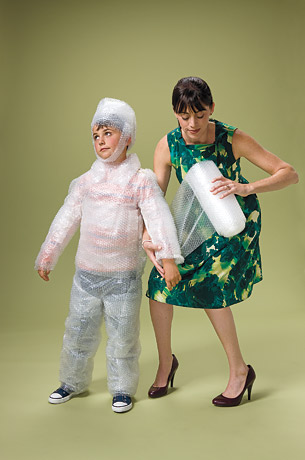
Ah yes, the "kid in bubble wrap" cliché...

I'll admit it. I've had this idea come up in creative sessions about family safety issues on many, many occasions.

via AOTW

But do you know why we don't end up using it? Because GIS, that's why.


When your "there's a better way..." concept is already a tired cliché in stock photo libraries and mommy blogs, it's time to start over. 


And not just with different materials, either...


Friday, October 7, 2011

F'd Ad Fridays: Don't get distracted by the headlights behind you

And by headlights,  I of course mean "headlights" in the parlance of our times.


This British (?) distracted driving PSA was a related video to the Farrah one from my last post. But whoever put it on YouTube cut off the branding and call-to-action. Does anyone know its origin? It certainly looks real, and of fairly recent vintage.

The poster claims it was "banned", but they all say that. It actually makes some pretty good points about both the passengers' and the divers' responsibilities when it comes to preventing distracted driving.

What not to do in the back of a boy's car. (Not while he's driving, anyway.)

Have a safe weekend.

F'd Ad Fridays: Lad Mag Humour

The first one is funny, the middle two awkward, and the last one kind of scary. (I don't think a laugh and some boobies are going to fix that one.) But together, they paint a pretty good socioeconomic portrait of Nuts Magazine's target readership.


The advertising seems a little misleading, too. The Nuts site ("Britain's number one men's website") is short on haha and heavy on hooters. It even offers to assess readers' (or, presumably, their aunties') breasts by adding them to the mammary menagerie.


Via AOTW

F'd Ad Fridays: Even ugly politicians get laid at Ashley Madison!

Copyranter posted this pic of an online extramarital dating ad. It was erected in London, and features the very Pythonesque mug of scruffy Mayor Boris Johnson.


Johnson is also known to scandal sheet readers as a womanizer, you see, through headlines like this:


Maybe he could benefit from meeting some more discreet homewreckers...

F'd Ad Fridays: Organic dairy boy band is no joke

And that, in itself, is ridiculous. Despite transplanting all the well-worn 'N Sync et cetera audio and video clichés to a farm setting, this campaign for Yeo Valley organic dairy never actually manages to be funny. Even the moo and the "Got Milk?" moustache shot seem genuine and earnest.


Meanwhile, AdFreak notes that this mad-up group, "Churned", will appear on Britain's The X Factor talent show and will have this song available on iTunes.

Is this some kind of super-subtle new British humour I'm not aware of?

Wednesday, October 5, 2011

British insurance company hits PR paydirt with banned ad

The Guardian reports that a British insurance firm has been busted by the Advertising Standards Authority for an ad that is "degrading to women".

They post it in censored form, but the ASA paints us a picture: "Underneath was a picture of a woman wearing only men's boxer briefs and holding a D-SLR camera to each breast."

So here's an artist's impression:

([ ])([ ])  
The company's defence was the classic "we're equal opportunity exploiters!"

"Versatile Insurance Professionals Ltd (Versatile) said Aaduki were well known in the photographic market for the ‘Aaduki Boys’, a group of male models used to advertise the brand at exhibitions and conventions and who also featured heavily in their marketing campaigns. They said they had run a series of ads across the specialist photographic press featuring the male models in their trademark blue shorts, which were designed to amuse the reader with ‘tongue in cheek’ innuendo much like the Carry On films from the 1970s. Versatile provided copies of the ads in the series, which they believed were suggestive and naughty without being obscene."


"Versatile said the idea behind the “Confused and don’t know where to look ad?” was that they now had a girl wearing the blue shorts instead of a boy, and aimed to engage the male photographer that did not normally find their ads attractive. Versatile said they did not believe the ad was sexist or degrading to women, and pointed out that many photographic magazines featured female models, some of whom would be completely naked and a large number of whom would be topless. They said they believed the ad was no more suggestive than models in the tabloid press. Versatile argued that the ad needed to be viewed in the context of the other ads in the campaign, and that rather than being sexist or degrading to women the ad actually addressed the inequalities of their previous advertising that had focused on the male models."
Whatever. The fact is, there is no downside to this ruling for Aaduki. The target market of "amateur photographers" (don't ever GIS that) would have been unfazed by the nudity and suggestiveness of the ad, and even if they thought it was tacky they'll see the brand as a victim of nanny state censorship now.

This is why censorship in advertising usually has unintended consequences, making heroes out of what are really unimaginative and vulgar advertisers. Better to expose their tactics and mock their cynicism, in my opinion. Education, not bannination.

Thanks to @adsoftheworld for sharing the link.

Thursday, September 29, 2011

Interactive Lynx vid is a lot of work for not much payoff

That's what she said:


When you click the timeline and click "5738" the tiresome innuendo of this video gets shortened to a few seconds of mild amusement.

Again, "That's what she said".

Via Copyranter

Thursday, September 22, 2011

Britain: What's so great about it?*

(*With a nod to every Irish, Scottish and Welshman/woman who has ever uttered that phrase.)

In advance of the 2012 London Olympics, The UK Department for Culture, Media and Sport has launched a postcard and poster campaign that cranks the nationalism up to WWII-era levels.

This time, however, the propaganda is aimed at the outside world. The campaign was developed by the DCMS on behalf of the Prime Minister, working with colleagues at the Foreign and Commonwealth Office, UK Trade & Investment, the Department for Business, Innovation and Skills, VisitBritain, and the British Council

The examples of "greatness" run the gamut from general themes like environment, scenery, research and technology to modern icons such as Wallace & Gromit, Richard Branson,  serial wife-killer Henry VIII and shoe fetishist Nicholas Kirkwood.

Below I've posted all the postcards (ignore the crop marks, they're converted PDFs). What do you think of Great Britain's newfound public patriotism? Is it just what they need, or is that kind of patriotism a little scary these days?


Thanks to Neil H. for the tip.

Monday, September 19, 2011

The most beautiful, nastiest, campaign nudes you will see today

These unsettling portraits are by by UK photog Rankin, known for his sexy and disturbing images. (As well as the most sexily disturbing PSA I have seen in quite some time—posted earlier on Osocio.)

For this job, conceived by Beta, London for the British Skin Foundation, the shock is toned down. The pictures are almost too beautiful for the message.

Heh heh heh... "bum crack"

Nice work, though. I hope it gets through.

Find out more about the campaign here.

Friday, September 2, 2011

F'd Ad Fridays: "F" is for "Fart joke"

And this one goes on way too long.


The worst part is listening to it at your desk on speakers. Oh well, at least your coworkers won't be bothering you for the next 20 minutes or so.

Tip via Adland