 |
| "Stops the noises" |
Showing posts with label Health. Show all posts
Showing posts with label Health. Show all posts
Friday, December 2, 2011

Thursday, November 17, 2011
This Australian ad is worth it
It's worth the initial disappointment of the expository super at the front. It's worth the awkwardness you feel as you see the twins interacting. Because the payoff is quite unexpected.
Nice work, Clemenger BBDO Melbourne
Via Healthy Ads
Nice work, Clemenger BBDO Melbourne
Via Healthy Ads
Sunday, November 13, 2011
Why I hate these anti-SIDS shock ads
Shock advertising is on its way out in social marketing in general. But if there's one target audience that still responds strongly to fear, it's new parents.
Which is why this campaign by the City of Milwaukee Health Department (via Osocio) does everything I hate. It dramatically overstates a risk, increases the fear and anxiety of new parents (especially mothers), and it is a lazy bid for attention and/or awards by the agency, Serve:


Co-sleeping is one of those issues that really polarizes parents. On one side, you have the "rule follower" parents, who accept the risk-averse dictates of public health authorities who say that babies sleeping in their parents' beds are more likely to die. Then you have the "intuitive" parents who question these dictates, based on their own feelings and diverse cultural practices.
According to celebrity baby-care expert Dr. Sears, there is a third way to look at the issue: statistically.
Which is why this campaign by the City of Milwaukee Health Department (via Osocio) does everything I hate. It dramatically overstates a risk, increases the fear and anxiety of new parents (especially mothers), and it is a lazy bid for attention and/or awards by the agency, Serve:


Co-sleeping is one of those issues that really polarizes parents. On one side, you have the "rule follower" parents, who accept the risk-averse dictates of public health authorities who say that babies sleeping in their parents' beds are more likely to die. Then you have the "intuitive" parents who question these dictates, based on their own feelings and diverse cultural practices.
According to celebrity baby-care expert Dr. Sears, there is a third way to look at the issue: statistically.
"During the 8-year period of this study, about 34,000 total cases of SIDS occurred in the U.S. (around 4250 per year). If 65 cases of non-SIDS accidental death occurred each year in a bed, and about 4250 cases of actual SIDS occurred overall each year, then the number of accidental deaths in an adult bed is only 1.5% of the total cases of SIDS.
There are two pieces of critical data that are missing that would allow us to determine the risk of SIDS or any cause of death in a bed versus a crib.
How many cases of actual SIDS occur in an adult bed versus in a crib?
How many babies sleep with their parents in the U.S., and how many sleep in cribs?
The data on the first question is available, but has anyone examined it? In fact, one independent researcher examined the CPSC's data and came to the opposite conclusion than did the CPSC - this data supports the conclusion that sleeping with your baby is actually SAFER than not sleeping with your baby. As for the second question, many people may think that very few babies sleep with their parents, but we shouldn't be too quick to assume this. The number of parents that bring their babies into their bed at 4 am is probably quite high. Some studies have shown that over half of parents bring their baby into bed with them at least part of the night. And the number that sleep with their infants the whole night is probably considerable as well. In fact, in most countries around the world sleeping with your baby is the norm, not the exception. And what is the incidence of SIDS in these countries? During the 1990s, in Japan the rate was only one tenth of the U.S. rate, and in Hong Kong, it was only 3% of the U.S. rate. These are just two examples. Some countries do have a higher rate of SIDS, depending on how SIDS is defined."What is going on here?
"Who is behind this new national campaign to warn parents not to sleep with their babies? In addition to the USCPSC [U.S. Consumer Product Safety Commission], the Juvenile Products Manufacturers Association (JPMA) is co-sponsoring this campaign. The JPMA? An association of crib manufacturers. This is a huge conflict of interest. Actually, this campaign is exactly in the interest of the JPMA."
I understand that many parents would rather not go against authoritarian advice when they believe it is a matter of life and death. I wouldn't advise them to. But my wife and I made the informed decision to keep our infant son in our bed. It actually made breastfeeding much easier for her, as she barely needed to wake up for night feedings. We believed it was far better for him, too, because he was fed at the first signs of restlessness and never had to wake up feeling abandoned and alone. (Dr. Ferber is an asshole, BTW.) And safety? We believed that it was far safer to have the baby with us, where we could directly detect and address any issues of respiratory distress, rather than trusting wireless technology to do it for us.
We also believe that SIDS has many causes, that are not well understood. Second-hand smoke, parental drug (including alcohol) abuse, poor nutrition, and suffocating bedclothes have all also been blamed. Breastfeeding, on the other hand, has been linked to lower SIDS rates. There are various explanations given for this, but I have my own theory: that close encounters with an engorged breast while feeding strengthens the baby's awareness of, and response to, the anti-smothering instinct. But I'm not a scientist. I'm just an adman who plays one on his blog.
Monday, October 31, 2011
An Open Letter to Hawkins Cheezies
Dear Mr. Hawkins
Today is Halloween, and I am giving out nothing but Cheezies.

This is not due to any obsession with your product. It is the best of its category, sure, but there are other reasons to give it out.
First of all, I am from Kingston. You are from Belleville. I now live in Ottawa. And your product gives me the opportunity to contribute to a regional family-owned business. My family and I buy local food as much as possible — Ontario wines, and local cheese, meat and produce. So the opportunity to make even our rare junk food purchases (sorry) locavorous is one we appreciate.
Second, I'm having more and more of a problem with chocolate these days. A child labour problem. So much of the cheap chocolate that will be given out tonight to excited children was illegally harvested by children their own age in Ghana and Ivory Coast. These kids are exposed to dangerous working conditions, climbing trees with machetes to harvest pods, and few of them go to school. Many are trafficked from neighbouring countries as slave labour. It's really sad.
That's why my wife and I have tried to move towards Fairtrade chocolate from another regional company, Camino. But that stuff is a little expensive for Halloween giveaways.
Your product, on the other hand, is very affordable. I just wish it had not been so hard to find. But I know how the companies of "Big Chips" dominate shelf space with money and pressure. My sharp-eyed son managed to find two 24-packs of 28g bags of Cheezies stuffed into a bottom shelf at the Halloween display in an Ottawa Wal-Mart. (We had to buy the rest in much more expensive 8-count bags from Metro.)
I was surprised how few Hawkins Cheezies I could find in local retail. Everyone seems to agree that yours are the best. Humpty Dumpty's cheese things and Cheetos both have long and scary ingredients lists, compared to yours — including MSG. People like your crunch better, too, and the fact that the orange stuff is not quite so stainingly neon.
I would have expected that Halloween was the perfect time to mount a strong regional campaign, touting your provenance and your goodness, to encourage parents around Ontario to act as brand ambassadors to hand out Cheezies samples at their doors. But I saw nothing.
You have a good product, but I'm afraid that your marketing is a little old fashioned. Why can't I find this beloved Canadian brand on Facebook? Where would I hear your great story, if I had not bothered to Google you? You need help.
And it's not just the "promotional" P of marketing that you need to work on. While the product tastes great, I note that you are a hold-out for still using hydrogenated vegetable oil. While my son doesn't eat enough Cheezies to make the small amount of trans fats a health issue, your competitors have already made the switch to better oils. You need to do that, ASAP. The war on trans fats is not going away.
The other thing you could do is make sure your product fully lives up to its local, wholesome, made-in-Canada heritage. If you're using Canadian corn, you should proudly say so. People like that. And while I don't expect you to go organic, as a family-owned company you could become a very popular champion of smaller, family-owned farms that use non-GMO corn. This would also be a great thing to add to your story. Finally, using real aged cheddar is part of your Canadian charm. Is the cheese made regionally, or provincially? This could also be a great story to tell.
And then there's the peanut thing. Humpty Dumpty got their cheese sticks certified peanut free. I'm sure you could, too.
Your product will never be health food. But it is a "feel-good" food. Wouldn't it be great if you were able to out-maneuver your larger competition in Canada by being the cheese-flavoured snack with more to feel good about?
This is a conversation I'd like to have. So if you're in the neighbourhood tonight, please drop by for some Cheezies.
Today is Halloween, and I am giving out nothing but Cheezies.
This is not due to any obsession with your product. It is the best of its category, sure, but there are other reasons to give it out.
First of all, I am from Kingston. You are from Belleville. I now live in Ottawa. And your product gives me the opportunity to contribute to a regional family-owned business. My family and I buy local food as much as possible — Ontario wines, and local cheese, meat and produce. So the opportunity to make even our rare junk food purchases (sorry) locavorous is one we appreciate.
Second, I'm having more and more of a problem with chocolate these days. A child labour problem. So much of the cheap chocolate that will be given out tonight to excited children was illegally harvested by children their own age in Ghana and Ivory Coast. These kids are exposed to dangerous working conditions, climbing trees with machetes to harvest pods, and few of them go to school. Many are trafficked from neighbouring countries as slave labour. It's really sad.
That's why my wife and I have tried to move towards Fairtrade chocolate from another regional company, Camino. But that stuff is a little expensive for Halloween giveaways.
Your product, on the other hand, is very affordable. I just wish it had not been so hard to find. But I know how the companies of "Big Chips" dominate shelf space with money and pressure. My sharp-eyed son managed to find two 24-packs of 28g bags of Cheezies stuffed into a bottom shelf at the Halloween display in an Ottawa Wal-Mart. (We had to buy the rest in much more expensive 8-count bags from Metro.)
 |
| Part of my Hawkins horde. |
I would have expected that Halloween was the perfect time to mount a strong regional campaign, touting your provenance and your goodness, to encourage parents around Ontario to act as brand ambassadors to hand out Cheezies samples at their doors. But I saw nothing.
You have a good product, but I'm afraid that your marketing is a little old fashioned. Why can't I find this beloved Canadian brand on Facebook? Where would I hear your great story, if I had not bothered to Google you? You need help.
And it's not just the "promotional" P of marketing that you need to work on. While the product tastes great, I note that you are a hold-out for still using hydrogenated vegetable oil. While my son doesn't eat enough Cheezies to make the small amount of trans fats a health issue, your competitors have already made the switch to better oils. You need to do that, ASAP. The war on trans fats is not going away.
The other thing you could do is make sure your product fully lives up to its local, wholesome, made-in-Canada heritage. If you're using Canadian corn, you should proudly say so. People like that. And while I don't expect you to go organic, as a family-owned company you could become a very popular champion of smaller, family-owned farms that use non-GMO corn. This would also be a great thing to add to your story. Finally, using real aged cheddar is part of your Canadian charm. Is the cheese made regionally, or provincially? This could also be a great story to tell.
And then there's the peanut thing. Humpty Dumpty got their cheese sticks certified peanut free. I'm sure you could, too.
Your product will never be health food. But it is a "feel-good" food. Wouldn't it be great if you were able to out-maneuver your larger competition in Canada by being the cheese-flavoured snack with more to feel good about?
This is a conversation I'd like to have. So if you're in the neighbourhood tonight, please drop by for some Cheezies.
Wednesday, October 26, 2011
Systemic Sickness
by Shaker Erica
I learned a useful new term from a friend the other day—the 'L-curve.' It's that graph you've probably seen around a lot of the Occupy Wall Street coverage, that line that shows wealth distribution across a specific population. A straight line means that the wealth is distributed evenly, and a lopsided, sagging curve means it's not. And these days, obviously, it's really, really not.
The blatant injustice of that is enough to piss off most of us on the face of it, but a recent post by Maia Szalavitz on Time.com's Healthland blog calls attention to a handful of studies that show that this kind of economic inequality doesn't just affect our pocketbooks. It affects our health. Our actual, physical health.
Szalavitz writes: "A growing body of research suggests that such inequality—more so than income or absolute wealth alone—has a profound influence on a population's health, in every socioeconomic group from rich to middle class to poor."
Yeah, you read that right—even that elusive 1% can't escape it.
It all comes down to the inherent stress of a stratified culture:
Szalavitz also tackles the inevitable victim-blaming:
Most of the people reading this blog already know that income equality stinks, and now there's another reason to add to the long list. Worse, we seem to have perfected it:
Here in Edinburgh, we have a tiny little occupation doing its bit for the worldwide movement. They have maybe twenty tents pitched in one of the many public gardens, and they haven't attracted much press. I haven't been able to join them, since I'm fortunate enough to have a job where I need to be, so a few days ago I bought about £15 in cheap goods—a couple of wind-up flashlights, a couple of blankets, some bread and peanut butter—and took it down to them.
A student (he said he's studying painting) guided me to the right tents, where I added my loaf of bread to the pile of donated bread, and my blankets to the pile of donated blankets. And then I left, glad to have done something, but nagged by the sense that it was hardly anything at all.
There's this one band of baboons, out there in the Savannah, that's been mentioned on Shakesville before, and Szalavitz brings them up here again. They're called the Forest Troop. Twenty or thirty years ago, the baddest of their badasses fought off big males from another group for the right to feast on some tainted garbage from a nearby restaurant. As a result, those alpha males got sick and died, leaving only the lower-class males and all the females and young. This remainder made a whole new society for themselves, an entirely new culture unheard of among baboons where kind behaviour was rewarded and bullying frowned upon. New males coming into the group learned the new customs, and now, long after the original males have died off, they're preserving this new, more egalitarian culture.

It's no coincidence—not by a long shot—that the first article about them here focused on the way the sexual violence and coercion that's normal in other baboon groups have been all but eliminated in the Forest Troop's new regime. Because, as we see over and over, this shit is all connected.
And according to Szalavitz, amongst the Forest Troop, "rank appeared not to affect stress and health."
All that worry about status? All that bullying and violence? Not much of an issue any more. And everyone—everyone—is better off for it.
As Eric Michael Johnson, author of the earlier article, puts it, "what we're ultimately after is social change."
So I drop off my little blankets at Edinburgh's little protest. The Occupy movements collect and grow like little drops of water, and slowly, slowly, we all start talking about it. People start noticing. Politicians start referring to "the 99%."
And I keep thinking, maybe. Just, maybe.
I learned a useful new term from a friend the other day—the 'L-curve.' It's that graph you've probably seen around a lot of the Occupy Wall Street coverage, that line that shows wealth distribution across a specific population. A straight line means that the wealth is distributed evenly, and a lopsided, sagging curve means it's not. And these days, obviously, it's really, really not.
The blatant injustice of that is enough to piss off most of us on the face of it, but a recent post by Maia Szalavitz on Time.com's Healthland blog calls attention to a handful of studies that show that this kind of economic inequality doesn't just affect our pocketbooks. It affects our health. Our actual, physical health.
Szalavitz writes: "A growing body of research suggests that such inequality—more so than income or absolute wealth alone—has a profound influence on a population's health, in every socioeconomic group from rich to middle class to poor."
Yeah, you read that right—even that elusive 1% can't escape it.
It all comes down to the inherent stress of a stratified culture:
As studies of wild baboons in Africa have shown, there are certain key side effects of inequality—namely, stress. Baboons have a rigidly enforced social hierarchy in which fights to win alpha status are common and higher-ranking males constantly abuse and bully those below them. Not surprisingly, this results in chronically elevated levels of stress hormones in the lower ranks.But:
[A] study found that alpha males—those at the very peak of the hierarchy—were actually just as stressed as their lowest-ranked followers.Tough to be king, huh?
Szalavitz also tackles the inevitable victim-blaming:
In humans, in fact, differences in health linked to social status—which tracks closely with economic status—have often been attributed only to addictions and to the generally bad health habits of the poor, such as eating a lousy diet. But baboons don't have these 'lifestyle factors' and yet increased mortality in the lower ranks is still seen.Besides, the effects are seen even when the people lower in the hierarchy aren't particularly poor themselves. A researcher in London who spent decades studying civil servants found that the mortality rates for the lowest-paid were three times that of their highest bosses. That's far worse than the baboons, and the baboon-bosses have fangs.
Most of the people reading this blog already know that income equality stinks, and now there's another reason to add to the long list. Worse, we seem to have perfected it:
As Stanford biologist Robert Sapolsky, who led much of the research in stress in African baboons, once told me: "When humans invented inequality and socioeconomic status, they came up with a dominance hierarchy that subordinates like nothing the primate world has ever seen before."Great, so, even the freaking baboons have us beat.
Here in Edinburgh, we have a tiny little occupation doing its bit for the worldwide movement. They have maybe twenty tents pitched in one of the many public gardens, and they haven't attracted much press. I haven't been able to join them, since I'm fortunate enough to have a job where I need to be, so a few days ago I bought about £15 in cheap goods—a couple of wind-up flashlights, a couple of blankets, some bread and peanut butter—and took it down to them.
A student (he said he's studying painting) guided me to the right tents, where I added my loaf of bread to the pile of donated bread, and my blankets to the pile of donated blankets. And then I left, glad to have done something, but nagged by the sense that it was hardly anything at all.
There's this one band of baboons, out there in the Savannah, that's been mentioned on Shakesville before, and Szalavitz brings them up here again. They're called the Forest Troop. Twenty or thirty years ago, the baddest of their badasses fought off big males from another group for the right to feast on some tainted garbage from a nearby restaurant. As a result, those alpha males got sick and died, leaving only the lower-class males and all the females and young. This remainder made a whole new society for themselves, an entirely new culture unheard of among baboons where kind behaviour was rewarded and bullying frowned upon. New males coming into the group learned the new customs, and now, long after the original males have died off, they're preserving this new, more egalitarian culture.
It's no coincidence—not by a long shot—that the first article about them here focused on the way the sexual violence and coercion that's normal in other baboon groups have been all but eliminated in the Forest Troop's new regime. Because, as we see over and over, this shit is all connected.
And according to Szalavitz, amongst the Forest Troop, "rank appeared not to affect stress and health."
All that worry about status? All that bullying and violence? Not much of an issue any more. And everyone—everyone—is better off for it.
As Eric Michael Johnson, author of the earlier article, puts it, "what we're ultimately after is social change."
So I drop off my little blankets at Edinburgh's little protest. The Occupy movements collect and grow like little drops of water, and slowly, slowly, we all start talking about it. People start noticing. Politicians start referring to "the 99%."
And I keep thinking, maybe. Just, maybe.
Thursday, October 13, 2011
Is this what childhood has come to?
I get the ads. I just hate them.


Why? Because they are telling the truth about what these little boxes do to kids. They isolate them from normal external and social stimulus and make them into obsessive couch potatoes.
Many parents might love the convenience of plugging your kid into personal digital media. Hey, they aren't running around causing trouble. They aren't talking at you non-stop. They aren't really asking for anything, except the latest game and some Kraft Dinner once in a while.
But you know what? Kids are supposed to be hard work. They learn by asking, interacting, and getting into all kinds of real world mayhem.
Yes, some games can reinforce mental skills, coordination, etc. But so does being in touch with the outside world. Kids need the right mix of both to grow up healthy and happy.
These ads may be intended as funny, but they're way too close to the reality I see around me to make me chuckle.
Ads via IBIA.


Why? Because they are telling the truth about what these little boxes do to kids. They isolate them from normal external and social stimulus and make them into obsessive couch potatoes.
Many parents might love the convenience of plugging your kid into personal digital media. Hey, they aren't running around causing trouble. They aren't talking at you non-stop. They aren't really asking for anything, except the latest game and some Kraft Dinner once in a while.
But you know what? Kids are supposed to be hard work. They learn by asking, interacting, and getting into all kinds of real world mayhem.
Yes, some games can reinforce mental skills, coordination, etc. But so does being in touch with the outside world. Kids need the right mix of both to grow up healthy and happy.
These ads may be intended as funny, but they're way too close to the reality I see around me to make me chuckle.
Ads via IBIA.
Tuesday, October 4, 2011
Taco Bell offers the latest in over-the-top stunt eating cuisine
Junk food junkies are always looking for the latest affront to public health. "Baconator? Awesome! Double Down? I'll have two! Gravy Pizza? Bring it on!"

And for those of you who can't help but stunt eat the latest mysterious fad, Eater confirms that the Facebook rumours are true: There really is a Taco Bell taco with a shell made out of Goddamn Doritos cheesy corn chips. But you have to go to California to get it.
As evidence, the LA Times posted this amateur video capture:
Not my cup of sodium, but I'm sure this will cap off many a drunken night for young men in the area.

And for those of you who can't help but stunt eat the latest mysterious fad, Eater confirms that the Facebook rumours are true: There really is a Taco Bell taco with a shell made out of Goddamn Doritos cheesy corn chips. But you have to go to California to get it.
As evidence, the LA Times posted this amateur video capture:
Not my cup of sodium, but I'm sure this will cap off many a drunken night for young men in the area.
Friday, September 30, 2011
F'd Ad Fridays: Selling drugs on campus
What a very, very bad idea:

Red Bull's back-to-school campaign promotes itself with this line:

In my parents' day, many students popped "diet pills" to improve academic performance. Everyone knows they drink lots of coffee and Coke. But is it really ethical to promote your stimulant-laden drink (not to mention all that sugar) to students as a way to have more fun in school?
Using stimulants to pull all-nighters is a bad idea. Mixing Red Bull with vodka to party all night is also a bad idea. Yes, students commonly do both of these things. But using their stupid susceptibility to high-risk behaviours as a way to market an energy drink is really, really evil.

Red Bull's back-to-school campaign promotes itself with this line:
In my parents' day, many students popped "diet pills" to improve academic performance. Everyone knows they drink lots of coffee and Coke. But is it really ethical to promote your stimulant-laden drink (not to mention all that sugar) to students as a way to have more fun in school?
Using stimulants to pull all-nighters is a bad idea. Mixing Red Bull with vodka to party all night is also a bad idea. Yes, students commonly do both of these things. But using their stupid susceptibility to high-risk behaviours as a way to market an energy drink is really, really evil.
Wednesday, September 28, 2011
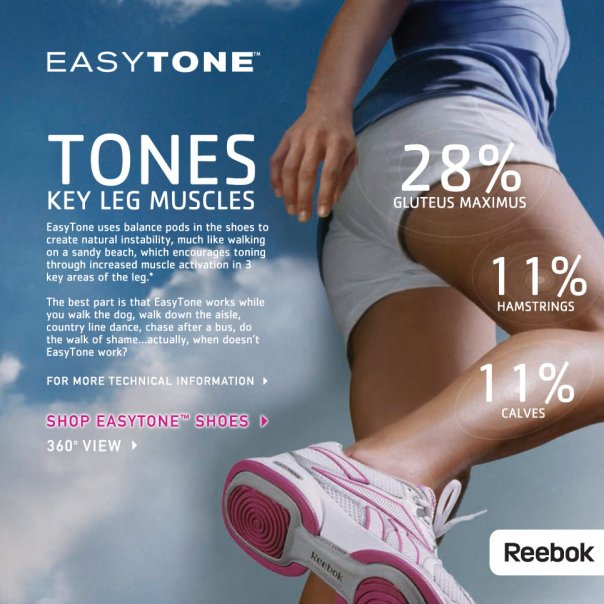
Reebok forced to refund over $25,000,000 to gullible Easytone buyers
The Consumerist reports that the United States Federal Trade Commission has ordered Reebok to give back over $25 million in refunds to buyers of its EasyTone shoes because of misleading advertising.
 |
| Image from here |
The article quotes the FTC:
"Reebok made unsupported claims in advertisements that walking in its EasyTone shoes and running in its RunTone running shoes strengthen and tone key leg and buttock (gluteus maximus) muscles more than regular shoes. The FTC's complaint also alleges that Reebok falsely claimed that walking in EasyTone footwear had been proven to lead to 28 percent more strength and tone in the buttock muscles, 11 percent more strength and tone in the hamstring muscles, and 11 percent more strength and tone in the calf muscles than regular walking shoes."
In addition to the refunds, Reebok is barred from the following:
• making claims that toning shoes and other toning apparel are effective in strengthening muscles, or that using the footwear will result in a specific percentage or amount of muscle toning or strengthening, unless the claims are true and backed by scientific evidence;
• making any health or fitness-related efficacy claims for toning shoes and other toning apparel unless the claims are true and backed by scientific evidence; and
• misrepresenting any tests, studies, or research results regarding toning shoes and other toning apparel
I am always skeptical about anything claiming to make it easier to shape up and lose weight. The promises of these shoes, and all similar brands, are simply too good to be true.
Of course, this won't stop deceptive health and fitness marketing. They'll just go back to making their promises more vague, and will distract us with T&A and cute babies and stuff. As always.
(Updated with video link from Adweek.)
Monday, September 26, 2011
The cheesiest ad you will see today
AdFreak shared this new provocation by Physicians Committee for Responsible Medicine:

It's going to be placed along the highway in De Pere, Wisconsin, where Green Bay Packers cheeseheads will see it on the way to Lambeau Field on Oct. 2 for a game against the Denver Broncos.
That's right, they want Wisconsinites to give up cheese.
From PCRM's release:
Oh, really?
In case you aren't familiar with these guys, they are actually an animal welfare organization in disguise. I have long considered them another front for PETA, although the relationship is arm's length, with PETA only providing them some funding.
There is no doubt that too much cheese is bad for your health. And Wisconsinites are overweight. But that's not really why PCRM wants people to stop eating cheese.
From Quackwatch:
Personally, I am much more concerned about cruelty to humans than cruelty to animals. What would you think if I went on a rant about inhumane child labour in the cultivation of chocolate, coffee or bananas, but then I suddenly told you that I wanted you to stop buying those things because I'm worried for your health? You'd question my motives. (And probably ask me why I didn't consider Fairtrade tropical goods.)
Anything is bad for you in excess. Factory farming is disgusting and cruel. And PCRM is not a very "responsible" advertiser, IMHO.

It's going to be placed along the highway in De Pere, Wisconsin, where Green Bay Packers cheeseheads will see it on the way to Lambeau Field on Oct. 2 for a game against the Denver Broncos.
That's right, they want Wisconsinites to give up cheese.
From PCRM's release:
"Foods served at Lambeau Field’s eateries are typically loaded with cheese and other high-fat dairy products. Offerings include Hall of Fame Curds, which are deep-fried Wisconsin cheese curds; Cheesehead Beer Cheese Soup, made with cheddar cheese, beer, and then topped with more cheese; and nachos piled with cheddar cheese and sour cream. Americans today eat three times as much cheese as they did in 1970—almost 33 pounds per person in a single year.
'Our greatest concern is for children who are fed cheese products by their well-meaning parents,' says PCRM nutrition education director Susan Levin, M.S., R.D. “Cheese is loaded with fat, cholesterol, sodium—and calories. It ought to come with a warning label so consumers understand the health risk."
Oh, really?
In case you aren't familiar with these guys, they are actually an animal welfare organization in disguise. I have long considered them another front for PETA, although the relationship is arm's length, with PETA only providing them some funding.
There is no doubt that too much cheese is bad for your health. And Wisconsinites are overweight. But that's not really why PCRM wants people to stop eating cheese.
From Quackwatch:
"The Physicians Committee for Responsible Medicine (PCRM) is a nonprofit association that claims to promote "optimal diet for prevention of disease," says there is evidence that humans don't have a specific requirement for protein, and teaches that "too much dietary protein from animal sources is detrimental to health." PCRM's reference to "animal sources" is key to understanding its true purpose. Its leader, Neal Barnard, MD, has been identified as medical adviser to the radical animal rights organization People for the Ethical Treatment of Animals (PETA), and PCRM may be substantially funded by it."Which is certainly their prerogative. But why not be more honest about their motives? Because a billboard that says "the dairy industry is cruel to cows" does not appeal to people's self interest. Instead, PCRM goes after the consumption of animal-based foods with dire warnings about health consequences.
Personally, I am much more concerned about cruelty to humans than cruelty to animals. What would you think if I went on a rant about inhumane child labour in the cultivation of chocolate, coffee or bananas, but then I suddenly told you that I wanted you to stop buying those things because I'm worried for your health? You'd question my motives. (And probably ask me why I didn't consider Fairtrade tropical goods.)
Anything is bad for you in excess. Factory farming is disgusting and cruel. And PCRM is not a very "responsible" advertiser, IMHO.
Monday, September 19, 2011
The most beautiful, nastiest, campaign nudes you will see today
These unsettling portraits are by by UK photog Rankin, known for his sexy and disturbing images. (As well as the most sexily disturbing PSA I have seen in quite some time—posted earlier on Osocio.)
For this job, conceived by Beta, London for the British Skin Foundation, the shock is toned down. The pictures are almost too beautiful for the message.


Nice work, though. I hope it gets through.
Find out more about the campaign here.
For this job, conceived by Beta, London for the British Skin Foundation, the shock is toned down. The pictures are almost too beautiful for the message.


 |
| Heh heh heh... "bum crack" |
Nice work, though. I hope it gets through.
Find out more about the campaign here.
Sunday, August 21, 2011
If sugar is fattening, how come so many kids are thin?
 |
| via |
Wednesday, April 7, 2010
Fish Spa in Turkey
Fish can help you to treat serious skin diseases. A special thermal spa in Turkey allows patients from all over the world swimming in the pool and letting the fish eat all infected parts of their skin. Fish “doctors” can help people to fight chronic, intractable diseases. Some people might find this treatment a bizarre method, but it’s very helpful!


Source: worldpicturenews


Source: worldpicturenews
Subscribe to:
Posts (Atom)